The next Municipal Election is Monday, October 26, 2026.
Internet Voting
Internet Voting opens on October 8th at 10:00 a.m. and closes on October 16th at 4:00 p.m.
Eligible electors may access the Internet Voting portal here during the voting period.
Who can vote?
To be eligible to vote, you must meet the Qualifications of Electors as listed in the
Municipal Elections Act, 1996, s.17(2).
A person is entitled to be an elector in a local municipal election if, on voting day, they meet all of the following conditions:
- They live in the local municipality, own or rent land there, or are the spouse of someone who owns or rents land there.
- They are a Canadian citizen.
- They are at least 18 years old.
- They are not prohibited from voting under subsection (3) or by any other law.
Voters List - How to Update Your Information
From September 1 to October 26, 2026, you can check whether you are on the Voters' List and submit an Application to Amend the Voters' List to update your information, add or remove your name, or request the removal of a deceased elector.
An Application to Amend the Voters' List may be submitted in person at any Chatham-Kent Municipal Centre or by attending an Advance Voting or Election Day location.
What's New This Election
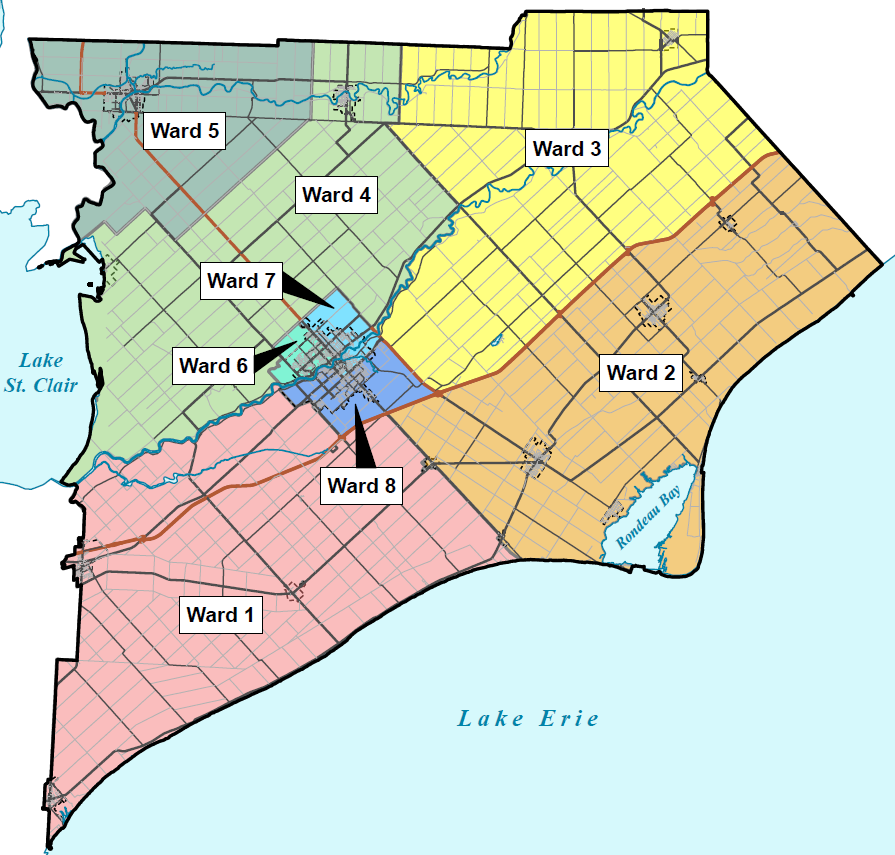
Ward Boundaries & Council Composition
We've updated our ward boundaries to better reflect our communities. Chatham-Kent is moving from six wards to eight for the 2026 Municipal Election. With the new ward boundaries, council composition is also changing. Instead of 18 seats, council will include 14 councillors and 1 mayor, for a total of 15 positions.
-
Ward 1: South West Kent — Tilbury, Wheatley, and surrounding areas (2 councillors)
-
Ward 2: South East Kent — Blenheim, Ridgetown, and surrounding areas (2 councillors)
-
Ward 3: North East Kent — Bothwell, Thamesville, and surrounding areas (1 councillors)
-
Ward 4: North West Kent — Dresden, Mitchell's Bay, and surrounding areas (1 councillors)
-
Ward 5: Wallaceburg — Wallaceburg and surrounding areas (2 councillors)
-
Ward 6: North West Chatham — west of St. Clair Street and north of the Thames River (2 councillors)
-
Ward 7: North East Chatham — east of St. Clair Street and north of Park Avenue (2 councillors)
-
Ward 8: South Chatham — south of Park Avenue and along the Thames River corridor (2 councillors)
Updating Your School Support
As of January 1, 2024, the
Municipal Property Assessment Corporation (MPAC) is no longer responsible for collecting voter information for municipal elections. However, MPAC is required to collect school support information.
Property owners in Ontario must designate support for a school system, even if they do not have children or if their children do not currently attend school. This designation appears on your Property Assessment Notice.
You can update your school support designation through
MPAC's Online School Support Tool. To learn more about school support, visit the
MPAC website.
Who can make contributions to a candidates campaign?
Anyone who lives in Ontario is allowed to donate to a candidate's campaign or to a registered third‑party advertiser to support their advertising efforts. An individual can give up to $1,200 to any one candidate, and another $1,200 to a single third‑party advertiser. These limits include the value of any goods or services you provide instead of money. In addition, you cannot contribute more than $5,000 total to all candidates running for positions on the same municipal council or school board, or to all third‑party advertisers registered in the same municipality. If you plan to donate, it's important to understand the contribution rules and keep track of your donations so you don't accidentally exceed the permitted amounts.
Organizations—such as neighbourhood groups, clubs, or professional associations like police or fire unions—are not allowed to make contributions to candidates or third‑party advertisers. However, individual members of those groups may donate on their own.
